

By Heather Green, Visitor Services and Programs Manager at Rose Hill Mansion & Johnston House
On the second floor of Rose Hill Mansion, there is a hole in the wall between the main stairway and the entrance to Robert and Margaret’s bedroom. Looking closer, you will see a brass pipe sticking out of the wall about ¼”. Even today, though it is missing several pieces, the pipe looks deliberate, and not like an accident that needs to be plastered over.

Once part of a communication network snaking its way throughout the house, this one pipe is all that is left. Though we do not know exactly where the other end would have been, there are a couple logical places.
To figure out where the other end would be, let’s look at why people wanted speaking tubes in the first place.
The first speaking tubes are difficult to pin down. Various theories, experiments and multiple development channels mean that tracking down a single inventor is nearly impossible. Even the first patent for one is buried among the dozens of patents for improvements on the speaking tube idea. These improvements mostly date from 1860-1890. Speaking tubes seem to have been invented or at least popularized around the time of an 1849 article about “acoustic telegraphs” in Scientific American magazine.
What historians agree on is that by the 1860s, speaking tubes were being installed in large office buildings for internal communication and the very wealthiest of houses to replace the bell system used to call servants

It is likely that Rose Hill originally had several speaking tubes that led down to the kitchen to relay orders for the day or to have hot water or tea brought up. Many of these types of speaking tubes were in bedrooms or dressing rooms – but not all. Occasionally a speaking tube in the hallway would lead to the kitchen for these requests. The Rose Hill speaking tube probably fits into this category.
Some houses also had a speaking tube in the second-floor hallway that led down to the door or the front hall where messages from the front door could be relayed upstairs. However, this seems to be rare in single family dwellings, except in the case of people who were on-call throughout the night, such as doctors.
No matter where the speaking tubes were located, yelling into the speaking tube trying to get someone’s attention does not convey decorum, so speaking tubes came equipped with a cover. This cover had a hole in it which whistled when blown into. The whistle alerted the servant to the fact that someone was at the speaking tube. The cover would then be lifted up, giving access to the tube for speaking and listening.
By 1883, speaking tubes were common enough in Geneva to be used as a description: “hollow like a speaking tube” was used in an article in the Geneva Advertiser in December of that year.
Clearly, with that common description, Rose Hill Mansion didn’t have the only set of speaking tubes in Geneva. Several people have spoken to me about their old houses with all or part of a speaking tube system still intact today. On top of that, the Prouty-Chew House which now houses the Geneva History Museum also has a speaking tube visible in the wall near the Welcome Desk.
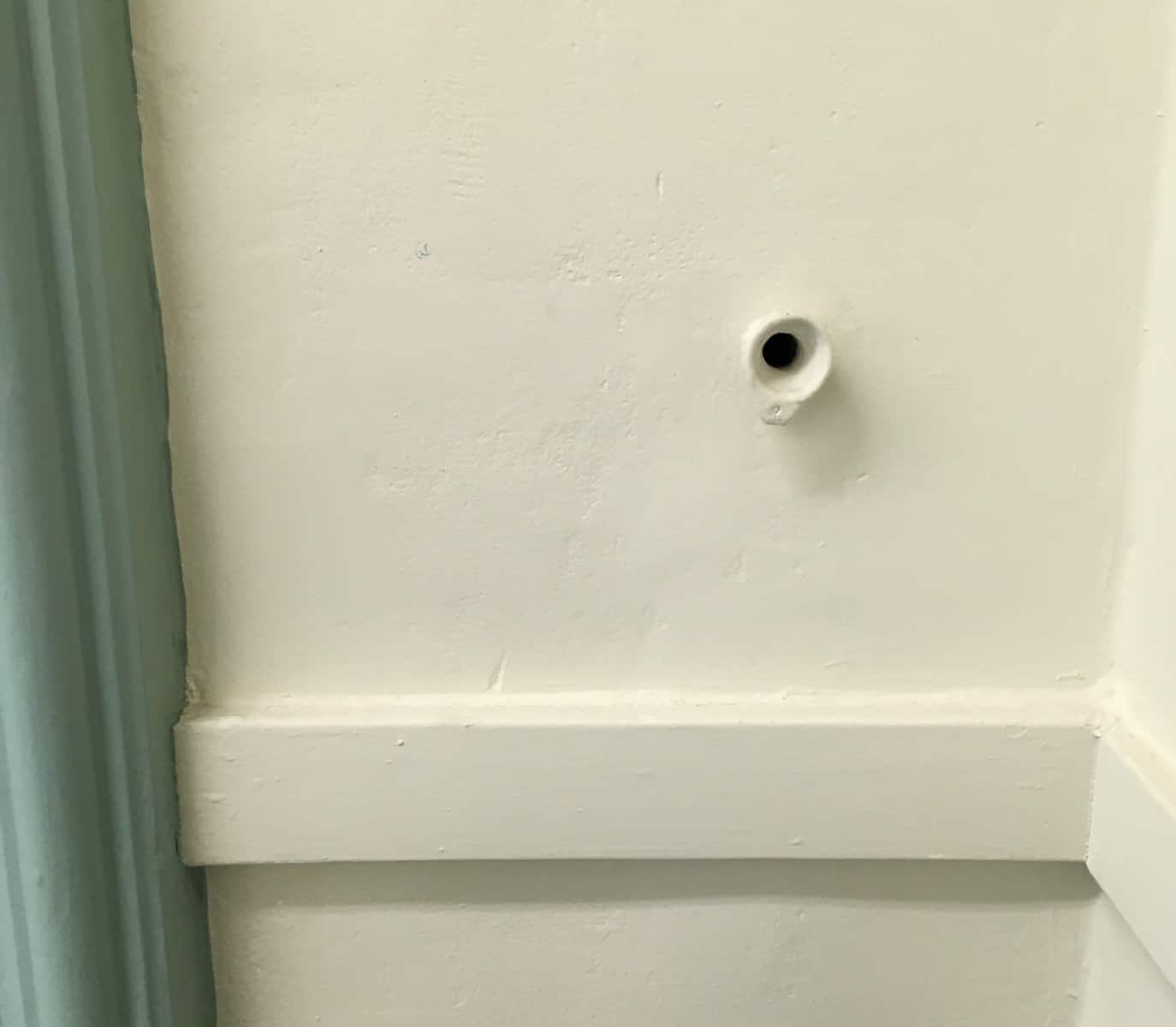
Keeping your eyes peeled in older homes is rewarding. Speaking tubes were in use until the mid-20th century, so you never know where you will find one.
At Home with the Swans: Breakfast Room
At Home with the Swans: Parlors
At Home with the Swans: Necessary Room
At Home with the Swans: The Kitchen
This article was brought to you in part by our supporters. Be our partner in telling Geneva’s stories by becoming a Historic Geneva supporter.