

American history is complex, and the ways we interpret it continue to evolve. As part of our yearlong celebration of America’s 250th birthday, we will be sharing local histories written by community members. While these materials reflect the times in which they were written, they remind us that how history told is also part of history.
Sarah Bradford (1818-1913) lived in Geneva during the mid-19th century. After her husband’s death she ran a girls’ school out her home and wrote several books. Today her best-known work is the autobiography of Harriet Tubman, who dictated the story of her life to Bradford in 1869.
Bradford was the first to write a history of the City of Geneva from its days as a Seneca village to “modern” times. Her history was published in the 1862 Geneva Directory. While not comprehensive, Bradford’s history is one of the earliest accounts of the founding of Geneva. The excerpt includes the early history of Geneva’s schools.
Geneva is justly famed for its educational establishments, which offer the best advantages to youth of every age and either sex.
The Walnut Hill School, which combines the rare advantages of extreme beauty of situation, with opportunities for the most through instruction, is taught by the Rev. Dr. T.C. Reed, formerly Professor of Union School.
The dwelling and School buildings, stand upon a hill surrounded by other hills, with deep ravines between, while shaded and romantic walks, a beautifully laid out and highly cultivated garden, glimpses of the Lake through the trees, and between the hills render it one of the most lovely and attractive situations in the country.

Commenced in 1852, with a small number of scholars, it has continued to grow steadily in reputation and numbers, the latter being unaffected by the pressure of the times. There are now fifty boarders, and a large number of day scholars. If these boys are not satisfied with their peculiar advantages for instruction, with their extensive play grounds where they may exercise in their various games in the summer, and the long steep hills which offer such facilities for the rapid descent of the sled in winter, all we can say is that they are hard to please.
Besides the Principal, there are three English Teachers, a German professor who teaches modern languages, and a Teacher of Music.
The high moral and religious tone of the Institution is well known, and its reputation for orderly conduct and the fine scholarship is unsurpassed.
The Union School of Geneva is one of the first Institutions of the kind established in the State. The plan was the first proposed by Mr. Francis Dwight, so well known for his deep interest in the cause of education in our State, and was submitted to Messrs. C.A. Cook, Perez Hastings, and Aaron Young.
After long consultations, the plan was proposed to the public, and a meeting of citizens was called. There was, for a time, strong opposition to the enterprise on the part of tax-payers, but the object was at last obtained, a large majority of the citizens voting for it, and in time those most opposed to the plan, became its warmest supporters.
Mr. Aaron Young, the only survivor of the first originators of this enterprise, informed me that for a long time this institution was taken as a model for others and that delegations constantly came from other towns in the State, to witness the operations of the Geneva Union School, in order to form others on the same plan.
On the 24 day of April 1839, School District No. 1 of Seneca, was formed from District No. 1 and 19, comprising the corporate bounds of the Village of Geneva. A sum, not exceeding $3,600 was voted by the new district, for purchasing a site, and erecting thereupon a suitable building. The site was purchased on Milton Street and a very commodious building erected on it, in 1839, having four rooms accommodating about 300 pupils and employing five teachers.
Mr. Isaac Swift was the first principal of this Institution, and held this position for 13 years. In 1842, the building was found insufficient, and the east wing of the main building was erected.
In 1852, Mr. J.E. Dexter succeed Mr. Swift, and in 1853 the west wing of the main building was erected, and all the rooms re-arranged and newly furnished; also three branch school houses, known as the North and South branches and colored schools.
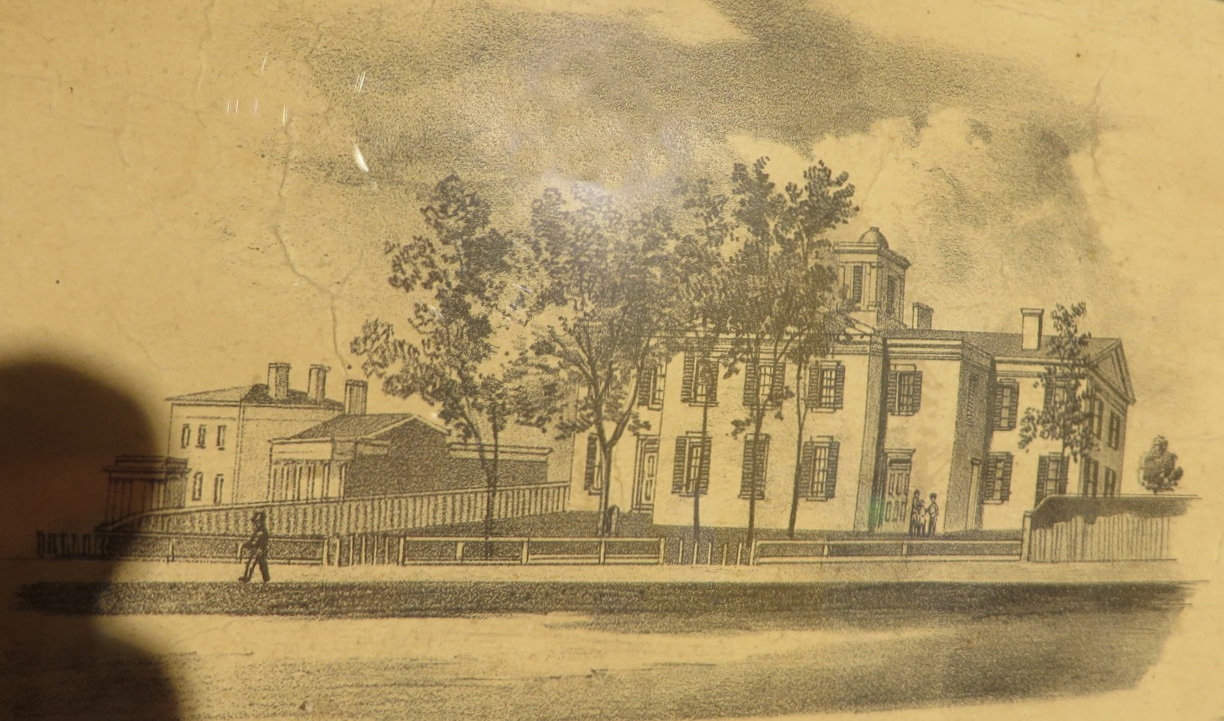
By an act passed April 15, 1853, incorporating Geneva Union School, and authorizing a Classical Department, it became subject to the Regents of the State, and entitled to a distributive share of the Literature fund. This Academic Department has enjoyed and still enjoys an excellent reputation.
In 1854, another branch building was erected on Lewis Street, called the Middle branch.
In 1855 Mr. E. M. Hutchins was selected as Principal and in 1857 Mr. B.I. Bristol.
The Geneva Union School accommodates over 800 pupils daily, and employs 14 or 15 teachers. These schools are carefully classed and graded, and embrace a complete common school and Academic course. The schools are free of charge to all residing in the district, although supported by a tax upon the property in the district, yet for three years past no one has cast a vote against it.
The Geneva Union School is designated also to instruct a normal class under the Regents. It has fitted many more men for College, many for teachers, and has sent abroad many more to occupy places of trust and honor. As it was the first institution of the kind in its organization, so now it is one of the first in moral and intellectual improvements.
The select boarding and day school of those accomplished ladies, the Misses Bridge, on Main Street, enjoys a well-deserved popularity.
The Seminary on the Square, taught by the Misses Field, who, from thorough training and long experience, are well adapted for their situation, presents every facility for the instruction of young ladies.
Sarah Bradford’s History of Geneva, Part 1
Sarah Bradford’s History of Geneva, Part 2
Sarah Bradford’s History of Geneva, Part 3
Sarah Bradford’s History of Geneva, Part 4
Sarah Bradford’s History of Geneva, Part 5
For more about Geneva’s schools, view the exhibit An Educated Citizenry: Education in Geneva, Part 1 and Part 2
This article was brought to you in part by our supporters. Be our partner in telling Geneva’s stories by becoming a Historic Geneva supporter.
2 Responses
Interesting history of the beginning of public schools in Geneva.
From the reading it seems as it was only for male students in the first part of the 1800s.
Pim,
The Walnut Hill School was a private school for boys, but the Union School formed in 1839 was coeducational, as were the two district schools that combined to form the Union School. You can read more about it in this post as well as several others on the public schools. There were many private schools for girls as well, including that of Mrs. Ricord.