

American history is complex, and the ways we interpret it continue to evolve. As part of our yearlong celebration of America’s 250th birthday, we will be sharing local histories written by community members. While these materials reflect the times in which they were written, they remind us that how history told is also part of history.
Dr. Robert Doran (1899-1983) graduated from Hobart College with a Bachelor of Science degree in 1922 and received a medical degree in 1926 from Syracuse Medical College. Along with his surgical practice in Geneva (1932-1974), he served as a consultant at Willard Hospital and as the city health officer. In his retirement Dr. Doran wrote his reminiscences, which were published in the Finger Lakes Times in the late 1970s and early 1980s.

Sampson Naval Base (August 2, 1977)
Little did I dream when we left Willard in 1909 that years later, I would return to the area as a Naval medical officer. We used to drive on the roads north of Indian Creek known to us as Rising ravine and ate peaches from the orchard at Buttonwood.
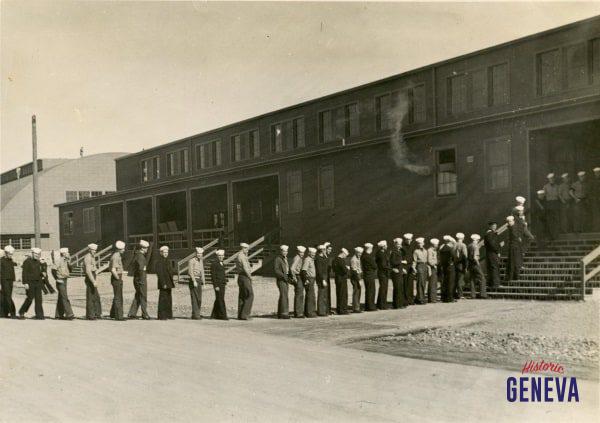
About the middle of May 1942, a large headline appeared in the paper: “Seneca Lake picked for the Big Sea Base.” Rumors flew thick and fast. Willard to be taken over by the Navy! Denied in a few days. The base to extend to the Yale farm. Not true either, but the truth was between the two extremes. Commander Gebhard of the construction corps of the navy appeared and set up a temporary office in the Seneca Hotel. Twelve thousand workers would be needed to build a training station costing $20 million. It was called Sampson in honor of Admiral Sampson of Spanish American War fame who was born in Palmyra.
By June 1 work was started; land acquired – people gave up their cottages or home and departed. Construction workers moved in, the area was cleared of crops and brush, roads were laid out, a railroad spur was built and equipment poured in.
To my complete surprise Commander Gebhart sent for me. I recall that it was just after word was received of the victory of the Battle of Midway and our spirits were greatly improved. I was asked to set up a field hospital and four first aid stations. The surgery was to be in my charge, hospital cases to be sent either to Willard or Geneva. I told the Commander that I had applied for a commission in the Medical Corps of the Navy a month before and might be called on active duty any time, but would do my best to get things started. A Dr. Crowder who had just come to Geneva was glad to man the field hospital, really a dispensary. He worked full time. First aid men were found and stations were set up in empty buildings. I am sure Seneca County never saw so much construction activity in such a short time. The John H. Johnston Crop and Mt. Vernon Construction Corp were the contractors and I was hired by them. Among other traders they wanted 7,500 carpenters, which was quite an order. Electricians and plumbers were also in great demand.
In spite of the fact that things were done in great hurry and often by people who were not highly skilled, we had few accidents. The most serious that I took care of was a man who was mowing a hay field; he stopped to clean an obstacle, stepped in front of the cutting bar, the team started up and he lost the lower part of his leg.
The sanitary arrangements, food inspection, etc. were under the supervision of the district health officer. Every day I visited the various first aid posts and I was paid a retaining fee plus standard workman’s compensation fees for the injured. By today’s standards it wasn’t very much.
My service did not last long. In the middle of July my commission was received and early in August I left for duty at the Norfolk Naval Hospital of Portsmouth, VA. My job with the contractors was turned over to Dr. Philip W. Skinner.
A week or so before I left I became acquainted with Capt. Carr, the prospective medical officer in command of the Naval Hospital. Again, I was surprised or should I say astonished, when he told me that he would request my transfer to Sampson. So I came to pass that about December 1, I returned to the Finger Lakes.
Sampson Opening (August 30, 1977)
On my return to Sampson in late ’42 I found that the hospital was still in the construction stage but things were moving fast.
Our temporary headquarters was in a building just south of the present park gate. Mr. Trotter, a warrant officer, was the first officer to report to Sampson and the last detached, by then a lieutenant commander. He knew all the Navy paperwork and was a tower of strength to the captain. At first there were about six medical officers who spent most of their time taking correspondence courses in naval regulations and customs.
Soon the various services were in outline form and assignments made on paper to wards, which by then were being painted. Ship’s company began to arrive as their barracks were ready. The great majority were brand new hospital corpsmen with some pharmacist mates. They were put to work cleaning the wards and scaping paint off the window panes which were pretty fouled up by the amateur painters.
Equipment for a 1,200-bed hospital arrived by carload – bed chairs, desks, surgical instruments, x-ray machines, galley and mess equipment with plenty of pails and swabs. All these things and hundreds more had to be put in their proper place and arranged for use. Each ward had a medical officer who was accountable for everything issued. Nurses spent a lot of time counting linen and swapping back and forth to make the count come out right.

Before the hospital was opened there were about two months when the doctors had little to do. In good weather we did some close order drill. In the later afternoon we were taken to one of the huge drill halls where we played volleyball. We also received lessons in abandoning ship and swimming lessons in how to cope with burning oil, unhappy thought.
Finally the last of February ’43 the hospital was placed in commission. The ceremony was held in the hospital auditorium where there were seats for a number of civilian guests. The corpsmen, nurses, and doctors fell into ranks. The chaplain offered prayers for the success of the hospital. Captain Carr’s orders were read and he ordered the officer of the day to set the watch, with replied “Sir, the watch is set.” We were in business with patients from the training station but many others transferred from the Pacific.
The hospital was a separate command from the training station, although both were under the overall command of captain, later Commodore Badt. Actually I saw very little of the station. There each unit had assigned medical officers who spent all day examining recruits and treating minor ailments. Many of them developed sore ears from the constant use of the stethoscope. There were more dental officers than all the others put together. The commonest physical defect was poor teeth and these were treated at the station.
One day in the spring of ’43 all officers were ordered to report to one of the drill halls for a ceremony. We fell into ranks at attention. There were side boys at the door. Hand salute was ordered, the boatswain mate sounded his pipe and in came Rear Admiral Sigsbee U.S. Navy Retired. It seemed incredible that the captain of the Maine when she was blown up in Havana harbor could still be around. He gave us a short talk, mostly about Admiral Sampson for whom he had great regard.
The Naval Hospital (September 13, 1977)
The majority of the medical officers at the Naval Hospital at Sampson when it opened were from Upstate New York.
For most it was their first tour of duty. Two from New York City were very fine internists. Howard Bruen, a cardiologist, was so good that he was transferred to Bethesda and assigned the duty of caring for President Roosevelt. The chief of medicine, Dr. Bailye, had been chief of the medical service at the woman’s department of the Presbyterian Hospital in about a year he was transferred to Washington, given a spot promotion and put in charge of the Naval Medical Bulleting. I have never known a more diligent and conscientious physician. Often he kept our car pool waiting when he walked half a mile for one more check on a particular sick patient.
At first I had two orthopedic wards at the end of A Wing. Dr. Mel Stevens an ex-Yale football player and something of a celebrity was assigned to the service. The captain and exe handled him with kid gloves and he charmed or finagled his way into more time off than all the rest of the surgical service combined.
When Dr. Wilson, the chief of surgery, made commander, he was transferred and I took over his job. He had followed me as chief surgical resident at the Jersey City Center 10 years before. Most of the surgery consisted of hernia repairs, pilonidal cysts and appendectomies.
Orthopedics was mostly sprains, torn cartilage, an occasional fracture, and wounded transferred from the Pacific. There were few auto accidents as recruits had no cars. Ships company lived on the station and moved about by bus.
One night when I had surgical watch I was called to see a man who had stolen an officer’s car, gone for a joy ride and had an accident. After fixing him up I learned that the accident was at Seneca Yacht Club. The next morning, going by the place I found that he had hit the fence, rolled over a couple of times and landed on top of dinghy, completely crushing it. I got sympathy from the provost marshall, but nothing else.
During the 26 months I was at Sampson a most important event in the history of medicine took place, the introduction of penicillin.
It is probably impossible to those who were not in practice before its advent to imagine the great change that took place. At first the drug was very scarce and expensive, available only for the military. I recall giving a few empty vails for a window display in Geneva for a bond drive. They had cost about $500. Visiting professors from Buffalo, Rochester and Syracuse came to see cases which had been saved by this truly wonder drug.
Some of the cottages along the lake were used for officers quarters. One day two boys, the sons of doctors were playing in a boathouse. They found some shiny tubes about the size of .22 cal shells. Putting one on a rock they hit it with a stone. The dynamite cap went off and each boy lost an eye in spite of all the consultants from Rochester could do. This was our greatest tragedy but we almost had another.
Capt. Carr was an impetuous person. Sitting in my office which was next to his, I heard the exec tell him that one of the civilian gate guards needed a revolver. The captain said, “I have one here in my desk,” next there was a very loud bang. He had opened the drawer took out a .38 and to show that it wasn’t loaded pulled the trigger. The bullet ricocheted off a radiator, went through the partition, across my office and into the outside wall. Great excitement, until it was realized that the Old Man had fired a gun. Then people went quietly back to work. According to Navy regulations there should have been an investigation but there never was.
There were funny things, too. Some of the boys in the VD ward, this was before penicillin, caught a couple of rats. They made an enclosure for them with a little house. Name tags were put over the door. One was Capt. Carr and the other Capt. Whitehead, the exec.
A brand new nurse was reporting for duty to the Officer of the Day. She was bending over the counter when our gynecological-urinary surgeon came in and as he went by her he couldn’t resist giving her a poke. Instead of letting out a squeak she gave a blood curdling scream which brough everyone within earshot to see who was murdered.
The culprit ran into the x-ray and hid in the darkroom.
For more information about Geneva and World War II see, Close to the Heart of the War.
This article was brought to you in part by our supporters. Be our partner in telling Geneva’s stories by becoming a Historic Geneva supporter.
2 Responses
Very interesting article. Now Sampson is a State Park with both a Navy and Air Force Museum and is overrun with campers but has a great boat basin. I had the pleasure of knowing Dr. Bob Doran. I believe that his newspaper articles were published in book form (unfortunately I cannot locate my copy). Not only was Dr. Doran a local surgeon, he served for a number of years on the Geneva City Council and at one time served on the Board of Trustees of the Geneva Historical Society. Bob Doran was a great photographer of local events and historic places.
Interesting times in Geneva and Dr. Doran was a very interesting man. He was born at Willard where his father was a medical doctor, graduated from Hobart , medical school in Syracuse and then back to Geneva as an MD for the rest of his life mainly.
He was very active in the community and the articles he wrote for the FLTs were published as a book.
We have a copy of the book. Bob Doran and my late husband were colleagues and friends here in Geneva.
If you, Charlie, want to take a look at the book I will be happy to lend it to you.
I took it out of our library and looked through some of the other articles .
Thank you for bringing his interesting life to our attention again.
Pim