

By Heather Green, Visitor Services and Programs Manager at Rose Hill Mansion & Johnston House
As I settle into my new place here at Rose Hill and Johnston House, I have been reading about the families that called these buildings home. In these readings and my walks through the houses, I am drawn to the various items we use to tell the stories. This is not so strange for me – as you get to know me, you will learn that I like “things.” Specifically, I am intrigued by the differences and similarities between historical objects and what we use today.
A great thing about studying history is realizing much the past and the present have in common. Not just artifacts, but people, too. Like us, they lived their daily lives as best they could, balancing need and comfort. It is always interesting to learn how people lived, and one way to do that is by studying the things they owned.
If we can identify what they owned. A life-long student history, I always enjoy a good rendition of “Guess that artifact.” I invite you to join me on a walk through Rose Hill for a chance to play along as we explore the connections of past and present.
Artifact #1
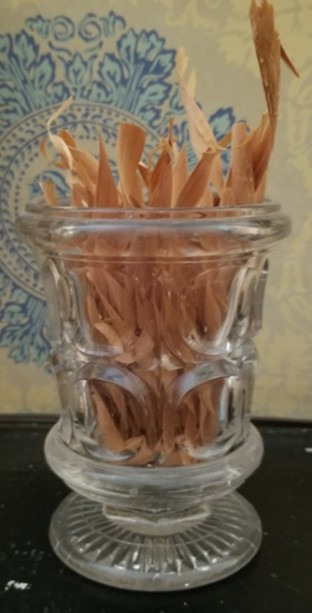
If you look at this and think that these are for kindling or starting fires, you have the same thought that I did when I first saw one. However, spills (as I learned that they are called) are akin to matches. The container is called a spill vase/holder. Walking through the mansion, you will see a few spill holders.
Spills are wood shavings or twisted paper used to light fires. They would be lit in the fireplace or off a candle to light another candle or perhaps a pipe. Since people from all socio-economic levels used fire for light, heat, and smoking, spill vases could be made from a variety of materials and with varying degrees of decoration.
Though we do not rely on fire to light or heat our homes today, matches still have their uses, especially at this time of year when candles make the long winter nights a little more cheerful.
Artifact #2
Not too far from the spill vase, you will see a fire extinguisher. There are a few of these around the mansion, near the fireplaces, of course. In a time when light and heat were created by burning wood, coal, oil, or gas, the Swans and everyone else would have to be diligent about fire safety. Bottles like these would have been filled with saltwater until about 1900. When a small fire happened, they would be thrown at the base of the fire to extinguish it.
Fire safety also reminds us that the Rose Hill farm buildings saw two major fires in the early 1900s, though not the mansion itself. Throughout history and in any socio-economic class, people have had to be diligent of the potential for fires to spread. Even today, though they look different, fire extinguishers are no less important than they were for the families at Rose Hill.
Artifact #3
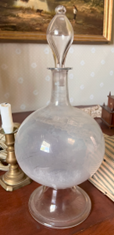
Looking like a decanter, this seems out of place in the Swan household, where they eschewed alcohol. However, this bottle would have been filled with water – and not for drinking. Placing a candle behind the water-filled globe would amplify the light, making it a particularly useful tool in the dark of winter. Though these globes were used by many people, including handcraft artisans, scientists, and doctors, their use is most often attributed to lace makers due to the light needed to see lace’s fine details to make properly.
We know that Agnes Swan Hutchins made lace. Since it does get quite dark early during New York winters, she might have used a similar globe.
We do not need water-filled globes to light our work today, but any number of lamps and light bulbs exist to perfectly illuminate whichever area of the room we choose. The needs have not changed; only the tools.
Artifact #4
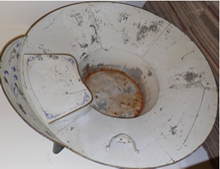
We sometimes equate modern plumbing with a sudden discovery of daily bathing. While it was onerous to fill a giant bathtub with hot water before modern plumbing (so people did not do it often), it doesn’t mean that people didn’t like to be clean. It just means they had different ways of achieving cleanliness. Tucked away in a corner and stored on its side when not in use, this artifact could easily be overlooked when scanning a room. However, set down on the floor like an upside-down hat, a person could sit on the side and pour water over themselves. Obviously, it was not made for a leisurely soak, but one would be clean and refreshed after using it.
How many did you already know?
Artifact #1: Sandwich glass spill holder
Artifact #2: Fire Extinguisher Clyde Dowser Bottle
Artifact #3: Lacemaker’s Globe
Artifact #4: Tin bathtub, with seat and soap holder
Each of these items tells a story; each story connects us to the people of Rose Hill. We might or might not recognize these artifacts exactly, but we use other items today to fill similar needs. In the end, we are not so different from people throughout history.
This article was brought to you in part by our supporters. Be our partner in telling Geneva’s stories by becoming a Historic Geneva supporter.
3 Responses
Very interesting and I liked the way you presented these items. I was totally unfamiliar with spill and spills. Thanks for teaching me something new!
Fascinating
Thank you Heather for an inspiring blog about artifacts. Well written.
I have seen and knew about the first three but had no idea about #4