

(From the March/November 2002 Historical Society Newsletter)
American history is complex, and the ways we interpret it continue to evolve. As part of our yearlong celebration of America’s 250th birthday, we will be sharing local histories written by community members. While these materials reflect the times in which they were written, they remind us that how history told is also part of history.

Sarah Bradford (1818-1913) lived in Geneva during the mid-19th century. After her husband’s death she ran a girls’ school out her home and wrote several books. Today her best-known work is the autobiography of Harriet Tubman, who dictated the story of her life to Bradford in 1869.
Bradford was the first to write a history of the City of Geneva from its days as a Seneca village to “modern” times. Her history was published in the 1862 Geneva Directory. While not comprehensive, Bradford’s history is one of the earliest accounts of the founding of Geneva. The excerpt includes the creation of the Pre-Emption Line. Over the course of the year more selections from Bradford’s history will follow.
I think we have got back about as far as we can go, in our efforts to find the first traces of a settlement at Geneva, when we discover in June 1787, “a solitary log house, and that not finished, inhabited by one Jennings.” But before the close of another year, others had joined him, and Indian traders, had begun to settle on the bank of the Lake.
The pre-emptive title to this territory of the Genesee country was claimed by Massachusetts under its colonial charter, which comprehended the whole region between its North and South boundaries, from the Atlantic to the Pacific Ocean. The charter of the State of New York interfered with this claim, and after varied unsuccessful attempts to adjust their differences under the Congress of the old Confederation, they were happily terminated at last, by commissioners mutually appointed by each State, who met at Hartford in Connecticut, and on the 16th of December, 1786, agreed that Massachusetts cede to New York the sovereignty and jurisdiction of all the territory claimed by the former, within the limits of the latter; and that New York cede to Massachusetts the property of the soil, or in the words of the settlement, “the right of pre-emption of the soil from the native Indians,” to all the lands no in the State, lying west of a line running due North from the 82d mile stone, on the North boundary of Pennsylvania, to the British possessions in Canada, except a tract of one mile in width along the Niagara River.” This line commences in the 42d degree of North latitude, 82 miles west of the north-east corner of Pennsylvania, and is called the Pre-emption Line.” It runs through the middle of Seneca Lake, at its north end, about one mile east of Geneva and also through Sodus Bay. Dr Spafford in his Gazetteer of New York, says it proves to be the meridian of the city of Washington. But by mistake or design of one of the Surveyors, the line which should have run through the middle of Seneca Lake, took a north-westerly direction, when about twenty miles south of Geneva, and continued on to Lake Ontario; leaving Geneva, Lyons, and Sodus Bay in what was “the Gore” between the true and false Pre-Emption line,” the false one running along the road on the west side of Mr. James O. Sheldon’s farm, and now called the “Pre-Emption road.” This mistake made the land on which Geneva stands, for some time debatable ground, and before the title was settled, Canandaigua had quite the start of her.
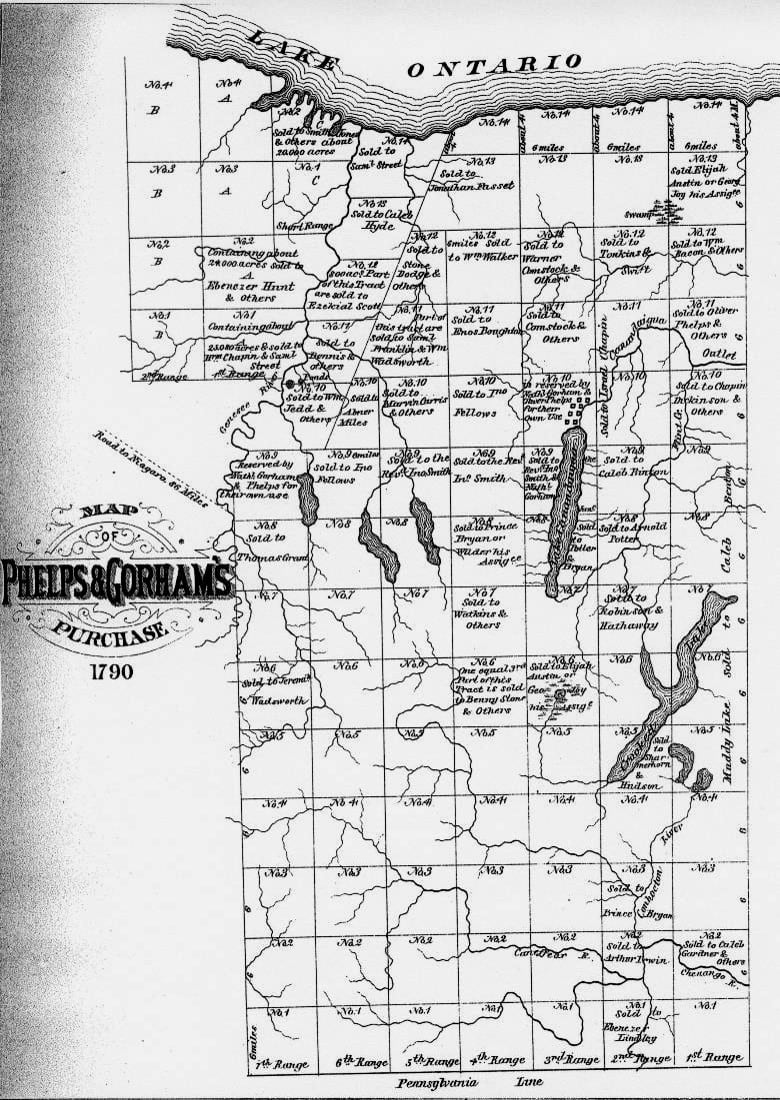
In 1787 Massachusetts said the whole of this tract, containing six million acres to Messrs. Oliver Phelps and Nathaniel Gorham, for one million dollars or three notes of 100,000 each, New England currency; payable in consolidated securities as par. In the following spring, Oliver Phelps, then living in Granville, Massachusetts, prepared himself with men and means to explore the country thus acquired and with great resolution and intrepidity, took leave of his family and his neighbors, together with the minister parish, who had assembled on the occasion, and started on his expedition, leaving them all in tears, bidding his a final adieu, scarcely hoping for his return from a wilderness in an Indian country hardly yet pacified…
Phelps arrived at Kanadesaga on the 4th of June 1788. The situation impressed him very favorably, as will be seen by the following extract from a letter to one of his associates. “I am well pleased,” he writes,” with that I have seen of the country. This place is situated at the foot of Seneca Lake, on a beautiful hill which overlooks the country around it and gives a fine prospect of the whole lake, which is about forty miles in length. Here we propose building the city, as there is a water carriage here to Schenectady, with only two carrying places, of one mile each.”
With exception of the rude dwellings of the Indian traders, and the settlement on Crooked Lake, called Jerusalem, of the that strange women Jemima Wilkinson, otherwise denominated “the Friend,” the only persons not of Indian blood, in all the Genesse Flats, a negro at Tonawanda and two or three traders at the mouth of Buffalo Creek.”
Not long after this, we find “the little village of Kanadesaga “becoming quite a brisk little place. Horatio Jones was living in a long house, covered with bark, on the bank of the Lake and had a small stock of goods for Indian trade. Asa Ransom occupied a hut and manufactured Indian trinkets; Lark Hennings had a log tavern on the bank of the lake, and there was a framed tavern, and trading establishment covered with bark, near where the bluff approaches the lake, occupied by Dr. Benton. There was also a cluster of log houses all along on the low ground near the lake shore. The geographical designations were “hill and bottom….”
This article was brought to you in part by our supporters. Be our partner in telling Geneva’s stories by becoming a Historic Geneva supporter.
Sarah Bradford’s History of Geneva, Part 1
Sarah Bradford’s History of Geneva, Part 3
Sarah Bradford’s History of Geneva, Part 4