

By Becky Chapin, Archivist
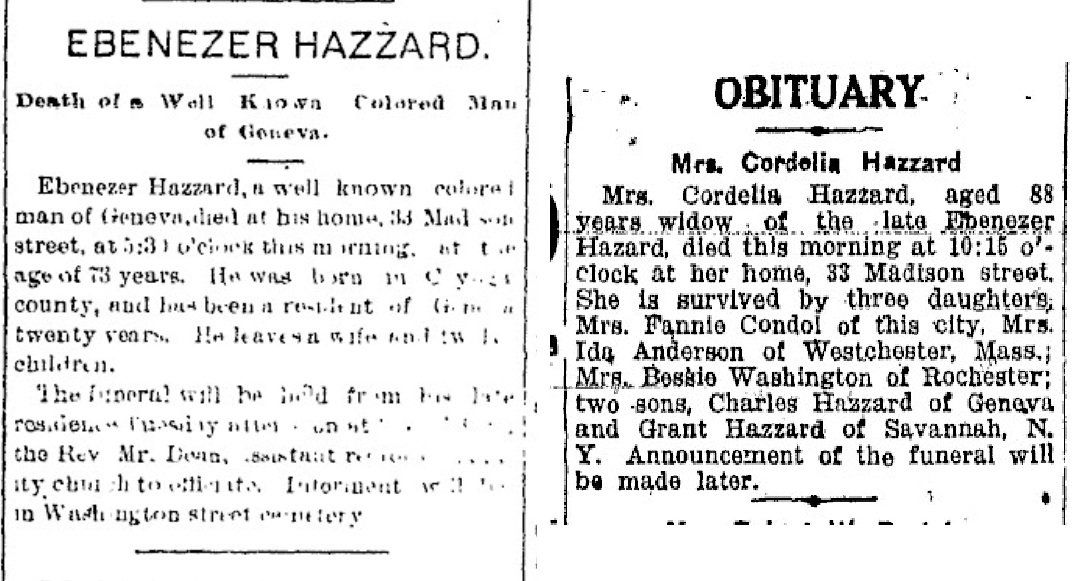
Albert ‘Bert’ Hazzard was born in 1875 in Geneva to Ebenezer and Cordelia Hazzard Jr. The second to last child of twelve children, Bert was the youngest boy. I’ve found little information about how the Hazzard family came to Geneva, however, they were a well-respected Black family in the city. Both Ebenezer and Cordelia received a couple paragraphs in the newspapers when they died. Though Ebenezer died in 1897, Cordelia lived to be 88 years old and outlived 7 of her children. The family lived at 33 Madison Street from the time Ebenezer and Cordelia moved to Geneva before 1850.
Bert Hazzard was interested in athletics his whole life, however it’s unclear when he met Marshall “Major” Taylor. It’s possible that Bert met him when one of his sisters moved to Worcester, Massachusetts after getting married. Originally from Indianapolis, Taylor moved to Worcester as a teenager in the 1890s to train in track and road cycling.
For the 1899 racing season, Bert Hazzard helped Taylor plan “an intense training regime involving weight lifting, running, boxing, and, when weather permitted, cycling.”[i] That same year, Taylor became the first Black American to achieve the level of world champion in 1899.
By 1900, Bert Hazard was living in New York City where he was labeled as the “trainer of the crack cyclist” Major Taylor, who was racing in Madison Square Garden.[ii]
Bert Hazard must have split his time between NYC and Geneva, as he becomes the manager of the Geneva Colored Athletic Association in the same year. The association spent the summer of 1900 playing baseball against other “colored athletic associations” in the area including Newark, Watkins Glen, and Clifton Springs in addition to the local high school team. The following year, Bert also helped organize the Colored Cuban Giants and played first base for the team, though it’s unlikely the team lasted very long. (There are a great number of teams with this same name in the early 1900s.)
In 1900, Bert Hazard found himself in the middle of a dispute between Major and the different cycling associations in America. Major was approached by an organizer from Paris, France to be involved in several of their races, however Major took the views of the Sabbath very seriously and refused to race on Sundays. This belief caused him to turn down the contract to go to Paris and brought up issues with the National Cycling Association.
Despite these issues, the following year Major signed a contract to go to Paris. Based on the Kerber and Kerber book The Inspiring Story of a Black Cyclist and the Men Who Helped Him Achieve Worldwide Fame, it does not appear that Bert Hazzard was with him. Major’s welcome in Europe was far better than his experiences with racism in America. In America, he was often turned away from hotels and restaurants and threatened with violence while trying to prepare for a race. Even his fellow American cyclists treated him with disdain.
Major returned to France in 1902 and a letter from Bert Hazzrd published in the local paper reveals that he was with him there as well. Bert described his journey from NYC to London to Belgium and on to Paris in April. He even reveals insight into how they were treated as people of color in Belgium:
We had a pleasant trip through Belgium. The people there had never seen a colored man before, or black man, as they said. You would have thought they trying to mob us, the way they crowded around us to get a look at Taylor. Everybody wanted to shake hands with him and as they looked at him they would exclaim in their native tongue “Wonderful, wonderful!” We had at one time to get officers to open a passage for us so that we could get through the crowd.
In May 1902, Bert Hazzrd writes again from Berlin, Germany and discusses Major’s races across Europe. Major won his first race in Paris and in total had won five out of seven. Overall, there would be twenty races in Germany, Italy, Switzerland, Spain, Holland, and Belgium.
I have met a good many people that speak English and every one has asked which city in Europe I thought the most beautiful. My choice for gayety and a lively time is Paris. But for a city of fine buildings and everything to make it beautiful there is not a city in Europe or America that can equal Berlin.
The 1902 season was the final time Bert Hazzard worked with Major, as Major signed on to race in Australia in 1903. He flourished in Australia alongside his new bride, Daisy Morris and made a fortune from his races there, winning 23 out of 27 races.
On June 24, 1903, Bert Hazzard and Nellie M Good of Washington, DC were married in Trinity Church in Geneva. On July 13, Nellie became ill and was taken to the Geneva City Hospital with typhoid fever. She was eventually taken home and on December 18, she died at the family home on Madison Street at age 21 years old. Her obituary was on the front page of the paper, quite notable for the time (as obituaries and death notices were usually on page 3).
Bert Hazzard ends up in Rochester for work by February 1904 and disappears from the census (both the 1905 New York and 1910 US censuses). However, he was still involved with athletics. After a six-day bicycle race in New York City in 1912, his health started to decline steadily. In June 1914, he was taken to Geneva City Hospital with an unknown illness. By October, he dies at age 39 after a “lingering illness.”
Ebenezer and Cordelia have a family plot in Washington Street Cemetery, and many of their children are buried with them, including Bert.
Bibliography and Further Reading
“Guide to the Marshall W. ‘Major’ Taylor Scrapbooks, 1897-1904 AIS.1984.07 | Digital Pitt.” n.d. Accessed May 22, 2026. https://digital.library.pitt.edu/islandora/object/pitt%3AUS-PPiU-ais198407/viewer.
Kerber, Conrad, and Terry Kerber. 2014. The Inspiring Story of a Black Cyclist and the Men Who Helped Him Achieve Worldwide Fame. Page 153. Skyhorse Publishing.
Beau, Jules (1864-1932) Photographe. 1902. “[Collection Jules Beau. Photographie Sportive] : T. 17. Année 1902 / Jules Beau.” Image. Gallica. https://gallica.bnf.fr/ark:/12148/btv1b84333441.
Wikipedia. 2026. “Major Taylor.” April 29. https://en.wikipedia.org/w/index.php?title=Major_Taylor&oldid=1351713788#1899:_World_sprint_champion.
[i] Kerber and Kerber, 2014.
[ii] 1902 Feb 3, Geneva Daily Times.
[iii] Beau 1902.
This article was brought to you in part by our supporters. Be our partner in telling Geneva’s stories by becoming a Historic Geneva supporter.
One Response
Thank you Becky. Another great article about Geneva’s history. Another Genevan that I have never heard of or read about.